…ok, so it's not a desk. It's probably a cell-phone, or maybe my laptop, but regardless, this is where you'll see me wrestle with thoughts, memories, and the questionability of societal norms.
I’ll never forget sitting in the back of the bus on my way to school and hearing those first few bars of Kryptonite through my Sony headphones for the first time as I listened along to my local hard-rock radio station, “WWBN, Tuscola, Flint, Saginaw… Flint’s Rock Radio, Banana 101.5!”
Something about the guitar tone, the snare centric drum beat and the composition of the song made it feel like a comfortable, worn in pair of blue jeans. It was new, but it felt vintage, raw and unique in an era when the first battles of the Loudness Wars were bubbling to the surface (The loudness wars were an era where sound engineers were pushing the boundaries of just how loud they could produce songs without distorting- The louder the song, the more it would stand out against the competition). I was hooked, and after I snatched up “The Better Life,” which was 3 Doors Down’s debut offering, I instantly became a fan. That album, which was released 26 years ago today (8 February 2000), felt like an absolute masterpiece from start-to-finish, and it became the soundtrack to my Summer in 2000, and well into my Junior year of High School.
In fact, if memory serves me correctly, a burned copy of the album made its way into my buddy Patrick’s “Black Rose Metallic” (it was purple and you can’t convince me otherwise) Chevrolet Beretta Z26 and didn’t leave the CD player for a solid year or two.
…and I don’t blame him, because it felt like each song on that album would find a mood to accompany- In my moments of shy, introverted insecurity, “Loser” would stand out, while “So I Need You” would punctuate those adolescent feelings of infatuation and “Be Like That” would elicit the deep rooted desires to achieve my dream of becoming a rockstar, and how it felt to be on the outside looking in.
As I began my foray into attempting to add the title of “guitar player” to my resume, my folks purchased the guitar sheet-music book for me, and I remember sitting in the grass in my parent’s backyard as I learned to play through the various tracks, with “Loser” holding the distinction of being the first song I’d ever learn to play from start to finish.
The more I’d learn about the band as years would pass, one of the things I found the most impressive was that singer Brad Arnold had actually recorded the drums on the album, which I always felt was a true testament to his musicianship. (Daniel Adair and Greg Upchurch, both extremely talented drummers in their own right, would take over subsequent drumming duties)
I continued my fandom through their subsequent album releases, and I loved to see their close ties to Dale Earnhardt Jr. (my favorite NASCAR driver following the death of Dale Earnhardt Sr.), and various veteran oriented charities, but I was elated that, after battles with addiction, Brad had finally come out on top, embracing sobriety in 2016…
Sadly, as has been reported on the official 3 Doors Down social media accounts, Brad Arnold passed away yesterday at the age of 47 after a battle with cancer.
It’s been said that you die twice- Once when your soul physically leave this earth, and once when people no longer speak your name, but the thing about “making it” as a musician is that even once you leave this earth, you still leave behind a legacy for people to enjoy and celebrate, and if you did it right- You just might live forever.
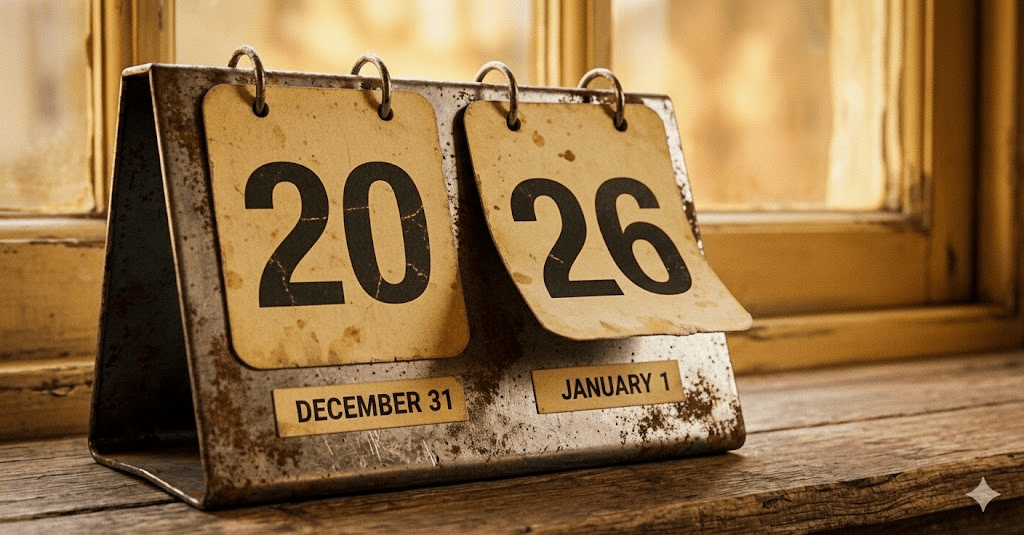
The dim lights of a still decorated Christmas tree cast a subtle grow as my little family of three retreated from our positions on the couch to huddle in the middle of the living room to watch the waning moments of 2025 tick away.
The countdown paced through its final seconds, 5-4-3-2-1, before a sea of confetti filled the air in New York City while the Constellation Ball, illuminated in a beautiful array of Red-White-and-Blue to celebrate our nation’s 250th birthday, completed its expertly timed journey. The television announcers proclaimed, “HAPPY NEW YEAR!” as Auld Lang Syne, the perennial anthem for New Years celebrations the world over, played in the background.
I kissed my wife, my forever New Years date (whom I met at a New Years party I was reluctant to attend in 2009), and we hugged as a family to celebrate the onset of 2026, but there’s something about that old Scottish melody that turns this gruff, cussin’, gun-slingin’, whiskey chuggin’ railroader into a sentimental mess, and those first few moments of the new year always feel more like a somber remembrance than a celebration of something new.
Anyone who knows me, knows that I love a good quote that helps place things into perspective; mostly because I recognize that there are people who are far cleverer than I am, and I embrace the collective knowledge and thinking that exists outside of my own head.
A great friend of mine sent me a quote the other day, and it said: “When we understand that each day isn’t one more day, but one less, we will start giving more value to the things that truly matter.”
The reality is that we’ve all experienced loss- A grandparent, a parent, a friend, a coworker, and with each loss we learn to live our lives in a new way as we establish a new normal without those people we’ve lost gracing the pages of our story any longer. Eventually, I think this guides us all towards the realization that everyone has an expiration date, and very few of us will ever know when our own story is coming to a close; nor do I believe we’d want to.
For me, as I’ve pored over the seemingly insurmountable piles of information my grandmother and mother have amassed surrounding my family’s genealogy, I began to wonder about my ancestors’ stories. Although I’ve been able to help add context to many of their Ancestry.com entries by virtue of military records, adding branch of service, rank, unit, or famous battles they’d participated in, I still can’t help but be curious. What were they like? What was important to them? What did they do for fun?
As we step into a new year, I don’t really think about it in terms of one more year- I think about it as one less year, and as we get older, the adage of “The days are long, but the years are short” begins to feel more and more real as the doldrums of day-to-day life, filled with anxiety and depression, tend to mute the beautiful moments that should grossly overshadow them.
Don’t get me wrong, I’m blessed to have a wonderful family, amazing friends, and a career that I’m passionate about, but after experiencing loss, and grief, I can’t help but feel terrified that my own story could come to a close long before I’m ready to be done writing it.
The sad reality is that many people will live their lives, only serving to leave their marks upon one another and their passing will see their stories fade into obscurity as people no longer speak their names, or share their stories. They’ll become just another name etched into stone, with two dates separated by a dash, and the best anyone can hope for is that they’ve made the most of that little dash.
I think British Comedian Jimmy Carr said it brilliantly, “Anxiety is worrying about the future, and depression is worrying about the past, so make sure at least a few times a day your head is where your feet are.”
For me, that’s my New Years Resolution- Not some overreaching New Year, New Me promise to lose a ton of weight, or be able to bench press 300 pounds (although both would be excellent goals), but just to keep my head where my feet are. To leave the past in the past and let the future come as it may. To strive, each day, to be slightly better than I was the day before, and to allow those beautiful moments to eclipse the mundane routines.
…because the days aren’t quite as long as I sometimes wish they were, but the years certainly are shorter than I remember, so let’s take a cup of kindness yet, for auld lang syne.
Happy New Year, everybody, make sure to try to keep your head where your feet are.
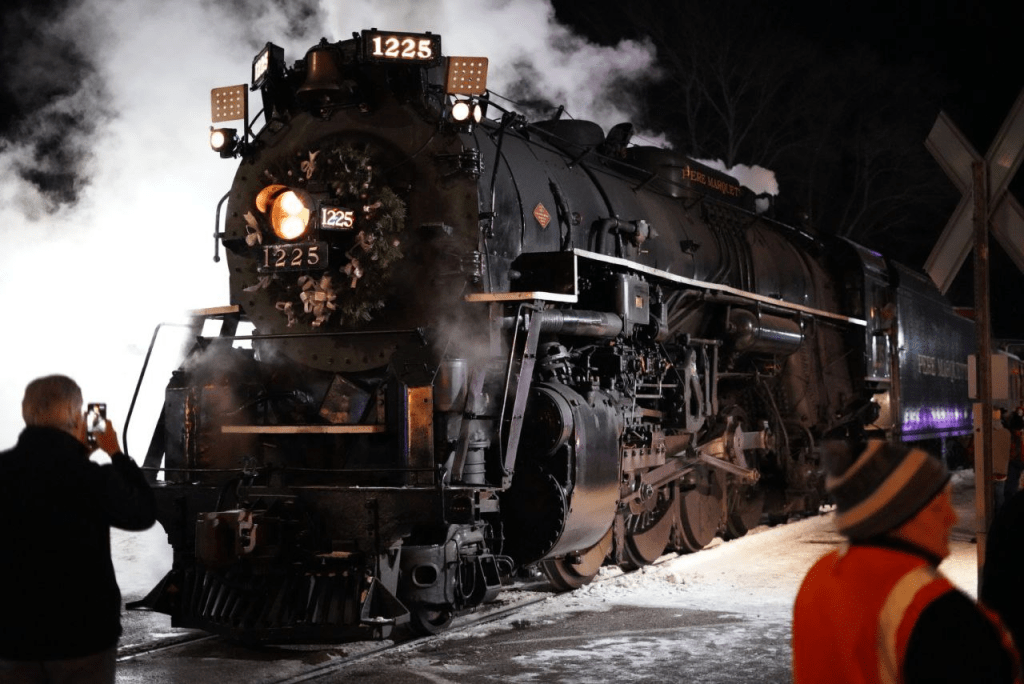
I flung the car door open to hear the inimitable sound of a brass Nathan 6-chime whistle howling into the cold December night. Just as has been portrayed in so many country-western songs, it’s hauntingly lonesome note echoed across the landscape as a column of black smoke and white steam plumed into the evening sky, breaking up the otherwise waning hues of blue that were rapidly giving way to the darkness of nightfall.
As we stood within the Steam Railroading Institute’s Visitors Center, it was hard not to feel the buzz of holiday excitement that emanated from the crowd of people that were browsing the gift shop, snapping selfies in front of a Christmas themed wall, or waiting in the will-call line, like us, to pick up their tickets for the evening ride.
At an organization that prides itself in being the curator of notable railroadiana, even the Visitor’s Center holds a rich history all its own, which over a century ago served as a Freight House for the Ann Arbor Railroad to move the furniture and caskets that were manufactured by the talented woodworkers of the area. After changing hands a few times, the building was acquired by the Steam Railroading Institute over 20-years ago, and has since been renovated to serve as a museum to display vintage railroad artifacts, a model train layout, and also handle the ticketing for their many passenger excursions throughout the year- Most notably those held around the Christmas holiday to celebrate Chris Van Allsburg’s iconic 1985 Children’s book, The Polar Express.
In 2004, the book would become the inspiration for a live-action animated movie directed by Robert Zemeckis, and starring Tom Hanks, which has its own ties to the Steam Railroading Institute as the Warner Bros. film crew travelled to Owosso to record the locomotive sounds for the film by utilizing the iconic Pere Marquette 2-8-4 Berkshire, which fittingly enough bears the road number “1225.”
In fact, it was the locomotive’s road number, and its perceived symbolic connection to Christmas that spared the 1225 from the scrappers torch when it was retired, eventually finding the behemoth being placed on static display at Michigan State University in 1957.
In 1971, the university railroad club began undertaking the daunting task of bringing the 1225 back to life, successfully firing the boiler and sounding the whistle in 1975, moving the locomotive under its own power in 1985, and eventually allowing the 1225 to begin its second life as a passenger excursion locomotive in 1988.
37 years later, my family and I stood patiently in the “A-G” line, patiently waiting to retrieve our tickets. It’s a train ride we’ve taken many times before, but this year was different. This year my mother had decided she’d prefer a quiet evening with her family in the privacy of a caboose.
Fortunately, as I close in on my fifteenth year of railroading, I’ve made a lot of friends along the way, including a gentleman by the name of Mike Burgett, who I met while working at CN. A man who is fairly well known in both the railfan and railroading communities, Mike previously served as the Senior Manager of Engineering- Signals Design at CN and now serves in the office adjacent to mine as the Chief Engineer for Communications & Signals at Lake State Railway Company. (Gosh, Mike- Why are you so obsessed with me?)
Since working for the railroad doesn’t provide him with enough time around trains, he spends his evenings and off days working on his world-renowned HO scale model-train layout, which portrays the Chesapeake & Ohio Clifton Forge Subdivision in breathtaking detail, just as it was in 1965. He also spends time volunteering at Henry Ford Museum & Greenfield Village (celebrating his 25th year in 2022) and serves on the Board of Directors at the Steam Railroading Institute.
Whew…
…but once upon a time, Mike was a railroad obsessed boy with a dream.
By the 1980’s, evolutions in technology had reduced the number of employees required to serve as part of a train crew which virtually eliminated the need for cabooses.
Railyards across the country began to find tracks filled with the once ubiquitous symbol of American railroading- a critical component in any model trainset to this day, but everything has an expiration date. CSX’s Saginaw Yard was no different, as a line of cabooses sat awaiting their disposition, and one could be had for a cool $1,500 (about $4,000 in 2025) so long as the new owner could successfully relocate the car.
While $1,500 was an undeniably fair price, it was still a bit out of the financial reach for a then 10-year-old Mike Burgett, so after much badgering, his mother finally relented and penned a letter to CSX’s corporate headquarters to ask if they might consider a discount for the budding rail-buff. Much to the Burgett’s surprise, a phone call several weeks later would find them as the proud new owner of a caboose, so long as they could work out the logistics surrounding how to relocate the railcar to their property.
Unfortunately, moving a railcar off the rails isn’t quite as simple as picking up a Lionel train car and placing it on a shelf, but fortunately a human-interest story in the local newspapers helped secure the necessary pieces of the puzzle, such as cranes, and even the rail, ties and ballast to place the caboose on at Mike’s house.
The Chesapeake & Ohio caboose that began life in 1941 as wood-sided 90091 and was rebuilt, modernized and renumbered in 1970 as 903674, now belonged to a 10-year-old boy who would make it his clubhouse for the rest of his childhood.
The thing about kids, is if everything goes according to plan, they grow up to become adults, and adults have responsibilities, obligations, and sadly, they no longer have time to play in their caboose clubhouse.
It would sit behind Mike’s parents’ home for decades, and though he had considered donating it to be displayed in the town he’d grown up in, a better option came to light- One that would allow him to, once again, spend as much time as he’d like in his storied caboose.
In 2023, Mike would donate the caboose to the Steam Railroading Institute, where he, and the talented back shop team of volunteers, would painstakingly restore the caboose to its original as-rebuilt condition to appear exactly as it would have when it rolled out of the C&O Wyoming Shops at Grand Rapids, Michigan.
If you’re reading this, I’m going to step out on a limb and assume you’re a pretty sharp individual, so I’m sure you’ve connected the dots already, but just in case you haven’t, I reached out to Mike to ensure that the private caboose we were to ride in would be his beloved “3674,” and he graciously obliged.
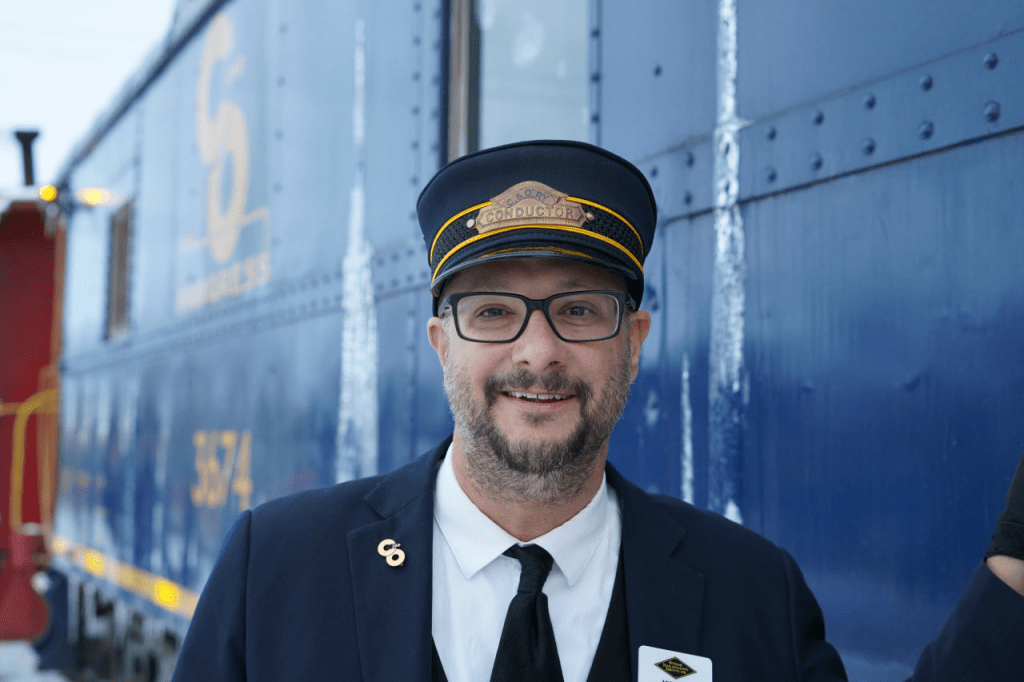
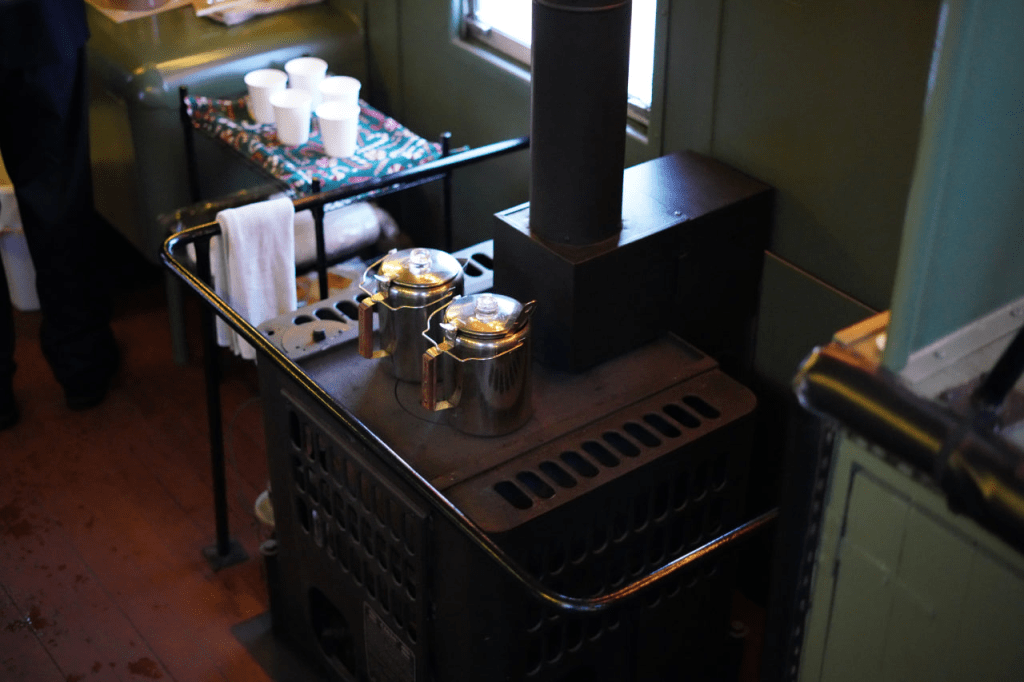
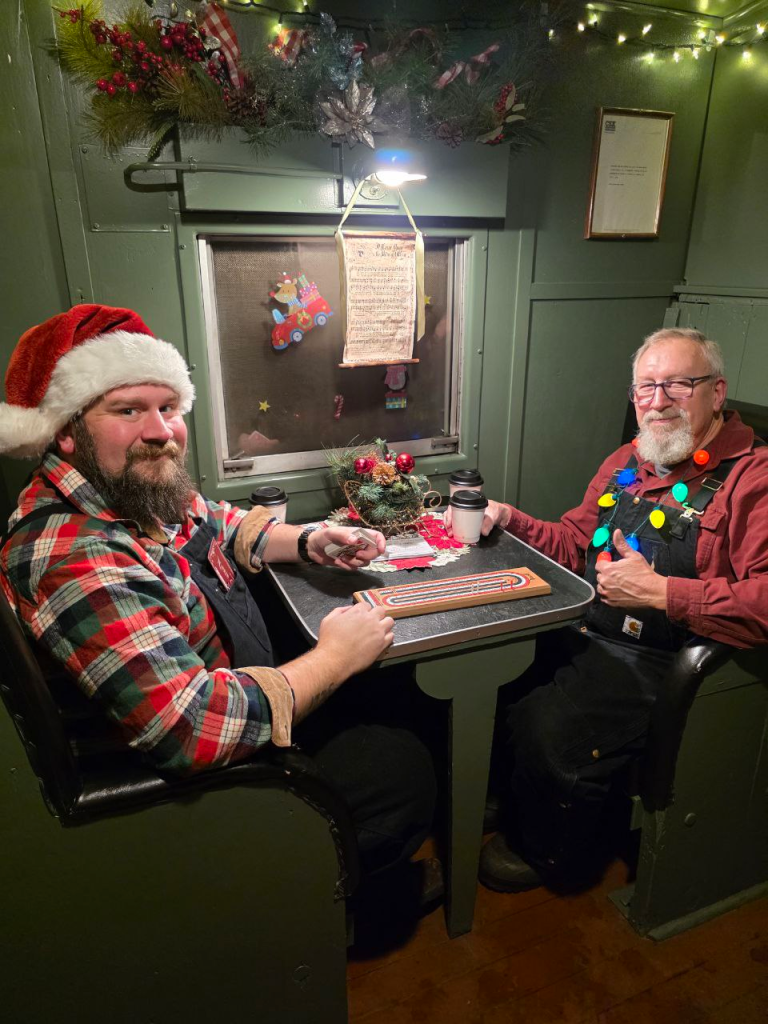
With his caboose positioned just two cars behind the iconic 1225, Mike welcomed us at the admission gate nearest the locomotive, dressed to the nines in authentic C&O passenger conductor regalia. As I approached the car, I admired the metal work that had been completed during its restoration, the blue paint gleaming in the setting sun, and the iconic “C&O For Progress” slogan proudly emblazoned on the side. As we boarded the car and stepped through the “A-end” door, I immediately felt the warmth of the air heated by the caboose’s oil fueled stove wash over me, reassuring me that this would be a cozy, comfortable evening.
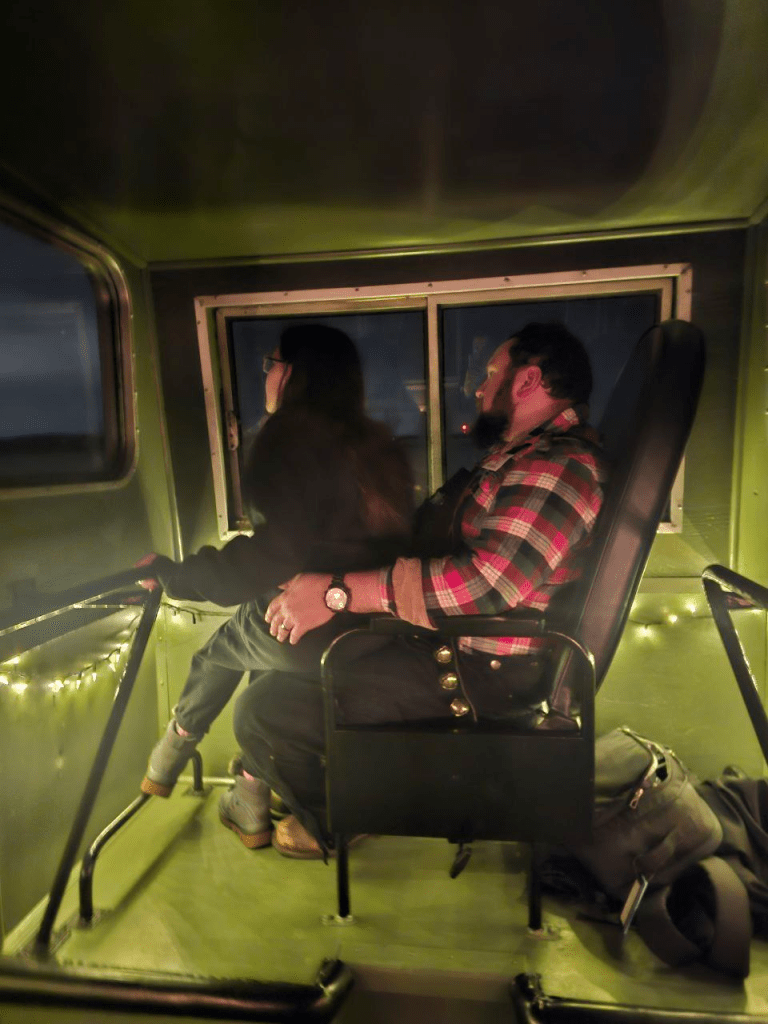
As we commenced our 20-plus mile journey to the city of Ashley- er… the North Pole, the cabin of the caboose was filled with the sounds of Christmas music and conversation as we all took turns climbing into the cupola- the watchtower like structure atop the caboose which provides the undeniably best view.
While many of the tickets for the Polar Express include a cup of hot chocolate, Mike boasted that his was the absolute best (and bottomless), and as we watched him prepare it atop the 3674’s original oil-stove, we had to agree.
Since I always keep a deck of cards and a board nearby, it didn’t take long before I challenged my dad to a game of Cribbage, a uniquely midwestern card-game that he had taught me at a young age- Since then, we’ve spent countless hours going back-and-forth counting our fifteen-for-twos, and scoring double-runs as we hoped to avoid being skunked (beaten by at least 30 points), or worse, double skunked (beaten by 60 points or more- it takes 121 points to win). I’m sure it certainly wasn’t the first game of cards played in this timeless railcar, and I wanted to keep the tradition alive as a few years earlier on Lake State Railway’s “Family Day” train ride we had played a few games on the “Dover Harbor,” a legendary Pullman heavyweight car that was built in 1923 and served the New York Central railroad for many decades.
As I pegged the final few points to seize a victory from my dad (the student becomes the master… sometimes…), we were arriving to the city of Ashley, a small town in mid-Michigan that transforms itself to serve as the North Pole for the seasonal Polar Express train-rides. With carnival rides, food trucks, various vendors, and even a sizable Christmas themed model-train layout, there’s always something to do to stay busy for the hour-and-a-half layover. While the food is good (seriously, try the fried Oreos) the star of the show is usually the 1225 as her passengers gather around for photographs of the locomotive that once faithfully served the Arsenal of Democracy as Michigan automotive facilities had been converted to produce tanks, bombers and other commodities necessary for the war effort.
Eventually, after all the pictures are taken, bellies are full, and Santa has drawn for the first gift of Christmas, it’s time for the train to reposition itself for all the passengers to board, which provides one last opportunity for photos of the 1225 pulling the train ahead before a diesel locomotive positioned on the opposite end of the train would tug it back towards Owosso to conclude the journey.
Worn out from the fresh air, aimless wandering, and carbohydrate-induced comas, the ride back was much more subdued, and I found myself back in the cupola, this time with my daughter in my lap. As we admired the Christmas lights that adorned houses along the route, and the railfans who were braving the bitter cold evening to catch a glimpse of the 1225 as it passed, the barrage of questions from an inquisitive mind let me know just how tired she was. Nevertheless, I attempted to satisfy her curious mind, answering as many questions as I could before she eventually resigned to quietly enjoying the ride, and appreciating the passing scenery the way I have for so many years as a conductor and locomotive engineer, crisscrossing the Midwest before making my way into management. Thankfully, she doesn’t remember the early years, or her birthdays that I’d missed when dad lived on the road, the hotels were a second home, and sleep came at a premium, if it even came at all.
Arriving in Owosso, with one more howl from the 1225’s whistle our trip would come to an end, but the prospect of a new year provides another opportunity to make memories with the people that I love, and I long ago learned that it’s not about what you find beneath the Christmas tree, but rather these moments we share with one another that is the real magic of Christmas.
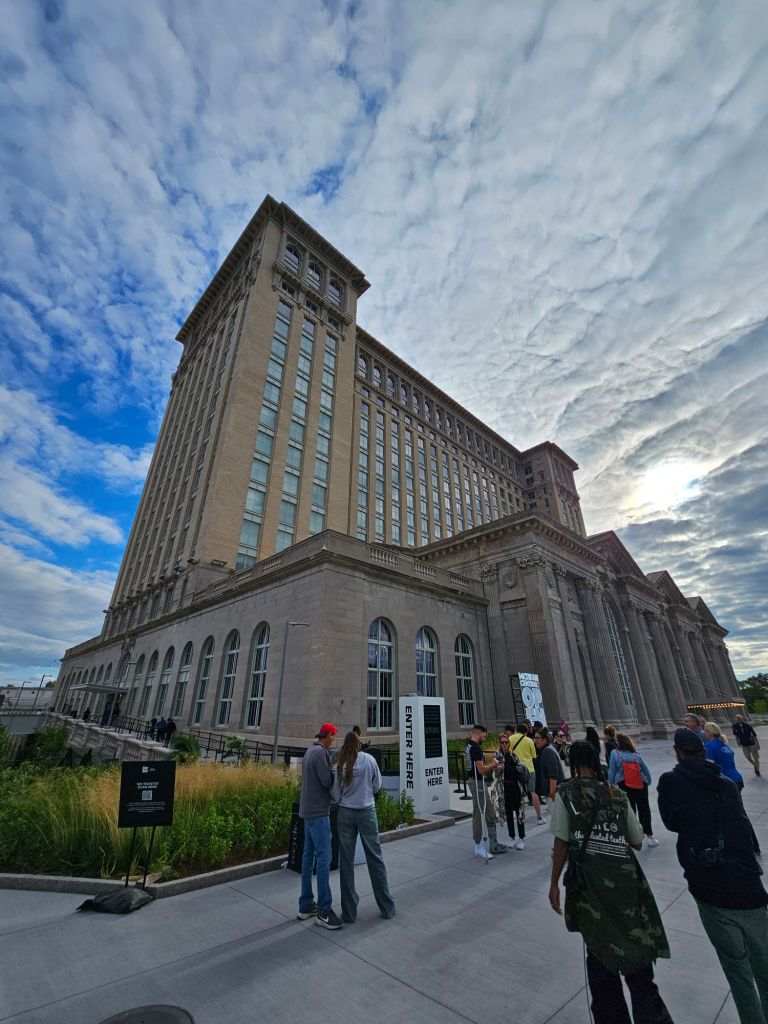
At the time of its completion, it was simultaneously the largest example of Beaux-Arts architectural styling and the tallest train station in the world.
RESURRECTION: MICHIGAN CENTRAL STATION
Having been designed by the same architects involved in the building of New York’s now world-famous Grand Central Terminal, it was, and is, simply known as “Michigan Central Station,” and while that may feel like a misnomer to those who believed its moniker to have been derived from an allusion to its geographic location within the state, or rail network, it wasn’t.
Michigan Central’s network connected Michigan to neighboring states and Canada
In fact, while some will praise him as a railroad magnate, with others chiding him as the first of the American robber-barons, the station was built to service Cornelius Vanderbilt’s Michigan Central Railroad. Also known as the MCRR, the railroad served Michigan as an independent subsidiary of the more expansive New York Central Railroad and was one of many railroads that connected Michigan to the rest of the country, and Canada.
What many don’t know, is that it wasn’t the first Michigan Central Station in Detroit.
Nearly a century before the area surrounding 3rd and West Jefferson would become the home of the Detroit Red Wings’ Joe Louis Arena, the original Michigan Central Station was erected.
Built in 1884 by the same individuals responsible for designing and erecting the Times Square building in New York, it was praised as the “Pride of Detroit,” and its Romanesque Revival architecture leant a stark resemblance to something of a medieval castle. However, on December 26th of 1913, a fire erupted, and within the first few hours it was known that the station could no longer serve its intended purpose.
Fortunately, as the demand for rail travel had grown wildly, as early as 1908 plans had already commenced to construct a new station, and less than four hours after fire ravaged the original Michigan Central Station, 5:20 PM saw a train bound for Bay City as the first to depart the new, not-yet-completed, Michigan Central Station, with the first arrival, a train from Chicago, coming only an hour later.
The Detroit Tribune would commend the railroad’s quick action, stating that trains were seamlessly arriving and departing the new station before the Firefighter’s hoses had even been disconnected at the smoldering site of the original Michigan Central Station, but it came at a cost.
What would have been an extravagant event to christen the new engineering marvel that towered over Detroit was cancelled, and the final few of the 18-floors that housed office space for Michigan Central Railroad staff as its headquarters would never be completed, still, in spite of this, the Railroad’s gamble had paid off, and at the height of its usage, the station saw more than 200 trainsper day moving everyone from common passengers to celebrities, dignitaries, soldiers, and even entire sports teams as they’d travel from city to city, vying for championships, which Detroit based teams had won 19 times during the life of the station.
However, in spite of a minor resurgence in rail travel during the gas shortages of the late 70’s and into the 80’s, the prevalence of automobiles, and the advent of Dwight D. Eisenhower’s interstate highway system in 1956, had already signaled the beginning of the end for rail travel in America, and on January 5th, 1988, at 11:30 AM, train 353, the final Amtrak train bound for Chicago, departed Michigan Central Station.
The next three decades would see the once proud symbol of Detroit fall further into decay, as haphazard plans were discussed that would’ve seen the iconic station repurposed into a casino, or even a new headquarters for the Detroit Police Department, but the cost prohibitive nature of a restoration ensured that none of those concepts would come to fruition.
Having passed closely by so many times when in Detroit, I’d often taken time to snap cell-phone photos, chronicling the urban decay that possessed its own charm and beauty. I’d seen the station used as the focal point for a drift-racing event in 2013, and as a backdrop in several films. In 2015, after a freight elevator had been installed within the facility, I stood in the shadow of the building, in awe, while windows were being installed throughout the 18-story tower, a sign that many speculated it would soon be sold.
I remained optimistic, but reserved- equipped with a realistic understanding of what would be required to resurrect the depot that had found itself added to the National Register of Historic Places in 1975. Fortunately, a move that would serve to spare its demolition time and again, much to the chagrin of many in the community who claimed it to be an eye-sore.
Still, it awaited someone- anyone- to breathe new life into it, and my hope was diminishing.
That is until 2018, when Bill Ford, Executive Chairman of the Ford Motor Company, had announced that Michigan Central Station had been acquired and it would become the new headquarters for the Ford Motor Company.
Admittedly, it was a bittersweet moment for me; As a lifelong “GM Guy,” it was hard to think of this iconic structure being the headquarters for what I’ve been conditioned to perceive as one of “my” brand’s greatest nemeses, but on the other hand, having known that the previous owner, Matty Maroun, would have rather seen the building lie in disrepair than sell, I was elated that there was the potential it could finally be resurrected.
For six years, I followed along with news stories, pictures, videos, social media posts, and admired from a distance as I heard inspiring stories from within. When I’d pass through, I’d see the changes.
None of the irony was lost on me. While Henry Ford’s obsession with the railroad was well chronicled, even acquiring his own railroad, the Detroit, Toledo & Ironton, that would operate its own passenger trains from Michigan Central Station. Unfortunately, it was his product, through his mass production methodology, that would serve to help render passenger rail travel commercially unviable in the United States. The resulting decline would see the abandonment of this iconic building, however, the company bearing his name would then eventually acquire it at a reported cost of $90M to resurrect it to its former glory the tune of $950M more. Ford Taketh Away, and Ford Giveth Back?
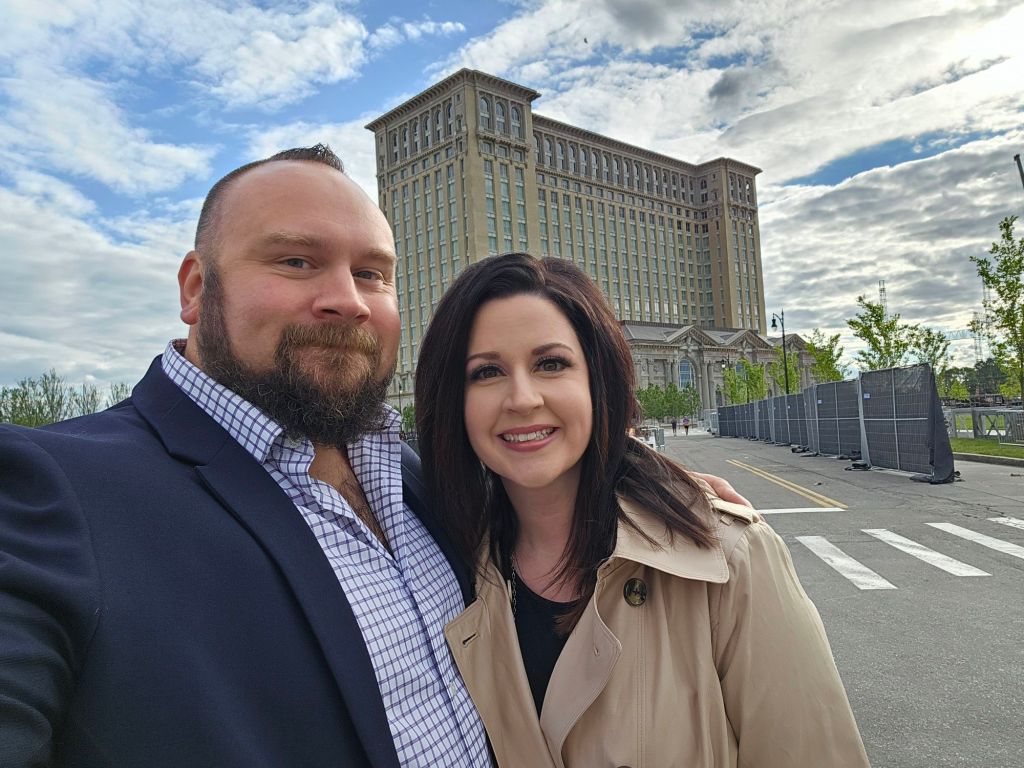
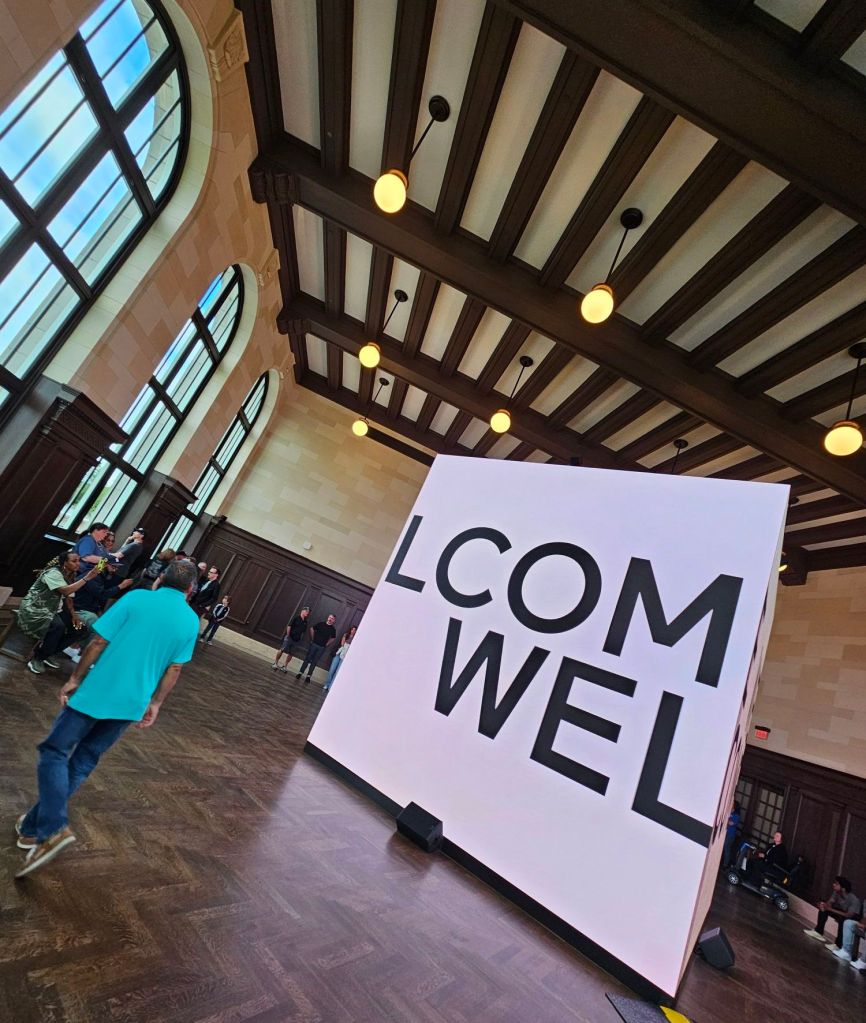
Following a night in which a huge concert event that featured Michigan artists like Eminem, Diana Ross, and Jack White alongside the Detroit Symphony Orchestra commemorated the grand re-opening of the station; something not afforded when it was rushed into service in late 1913, my wife and I were granted the opportunity to tour the station thanks to a few lifelong friends (Thank you, Pat & Sabrina!).
A sign of technological progress and advancement over the last century, and far removed from the paper tickets once exchanged to board trains from this very station, our QR code emblazoned tickets were scanned from our cellphones, and we were granted access.
A well produced video chronicling the heritage of Detroit and its impending resurgence welcomed all comers to the grand reopening
To say it was a visceral experience almost pales in comparison to how it actually felt. As I set foot on the beautifully refinished floors, and I gazed upon the vastness from within this structure that I’d admired so earnestly from afar for years, I was overcome with emotion. In fact, at several points throughout the tour, admittedly, I wept.
As I stood in what was once the lobby of a hustling and bustling train station that saw 4,000 people pass through each day, I appreciated the beautifully grandiose musical score that had been tastefully selected to be played throughout the tour, and I appreciated it being occasionally punctuated by seemingly original recordings of station announcements, such as “New York Central Wolverine, now arriving, Track 16.”
Looking into the lobby of Michigan Central Station from the ticketing area; On display are the Corinthian columns, re-created chandeliers, hand-restored ceiling tile, and a myriad of other details all culminating in a beautiful restoration project by the Ford Motor Co.
Pausing to listen to each one, I had to wonder if they had been recreated, or if someone was able to source original announcements that would’ve once echoed throughout these same halls.
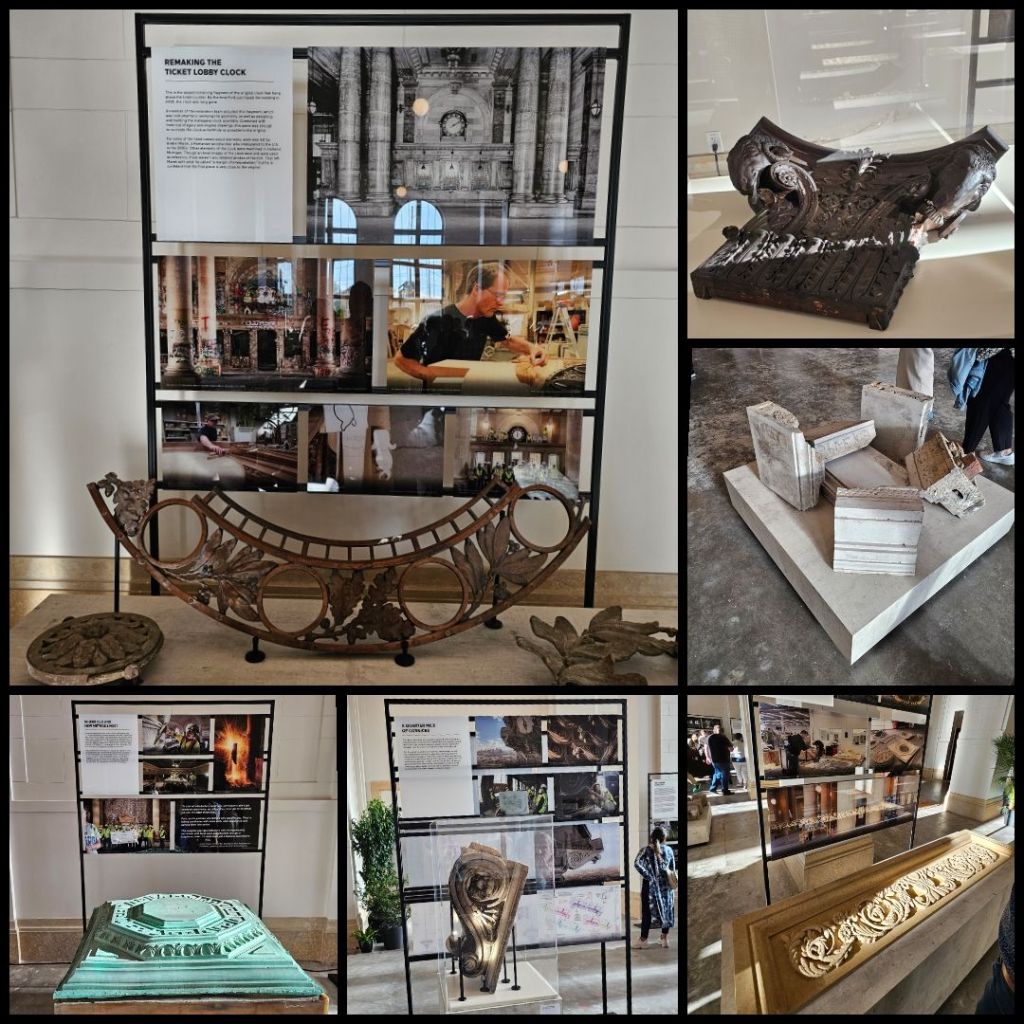
Many items had to be meticulously recreated from whatever examples could be found
On display were countless artifacts that illustrated the painstaking efforts that were undertaken to faithfully recreate each and every detail, with genuine efforts given to utilize any, and every original item and material possible.
Although a plea was issued for those who possessed any original artifacts from Michigan Central Station to return them, with no questions asked, the team chronicled how they embraced modern technology to three-dimensionally scan, and re-create whatever no longer existed from examples, or fragments, they did have.
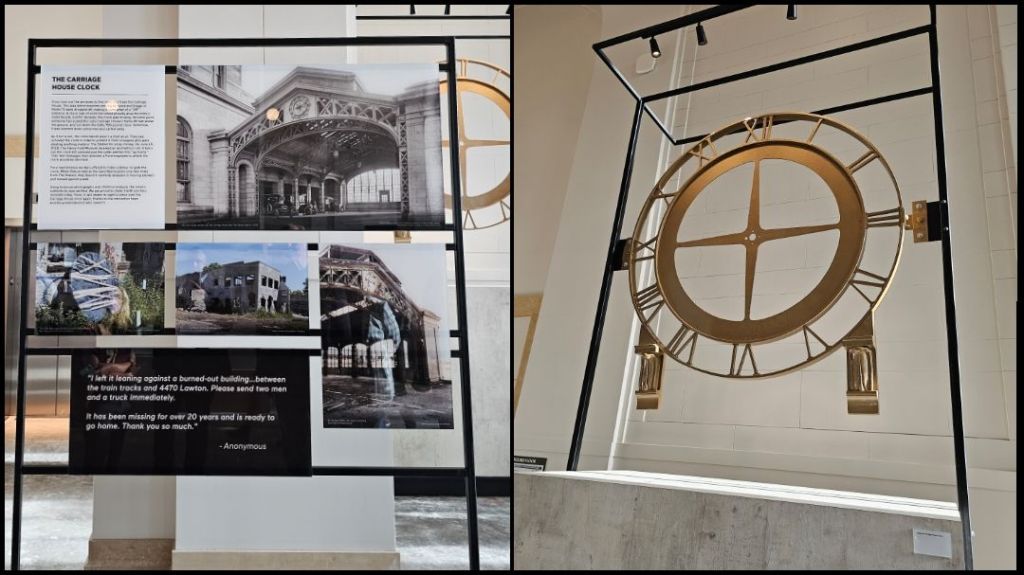
Amazingly, their pleas would be answered as numerous items would be returned, most notably the Carriage House Clock. Although it was assumed, like much of what had been stolen, that the 700-pound clock had succumbed to scrappers, it had actually been miraculously removed by an individual who wished to save it from such a fate.
“I left it leaning against a burned-out building… between the train tracks and 4470 Lawton. Please send two men and a truck immediately. It has been missing for over 20 years and is ready to go home. Thank you so much.”
The Carriage House was somewhat of a VIP entrance for those arriving to the station by Model T, or horse and carriage
I gazed upon the clock, and again, I was overcome with emotion, this time because I felt an overwhelming sense of appreciation that there are still good people in this world who simply wish to preserve history.
As I slowly paced through the 111-year-old building, I attempted to soak in every detail. The once time-stained Corinthian columns were returned to their original beauty, and the tiled ceiling had been meticulously hand-cleaned, with 8.2 million feet of grout utilized to replicate what would have existed when the station first opened.
Message in a bottle: A Stroh’s Bohemian Beer bottle featured a note from contractors who had helped build the station
In display cases were items found within, or associated with the station- Old train tickets, railroad lanterns, stock certificates, even sections of plaster that had been preserved with graffiti intact, each of them telling another piece of the story, with one such artifact, a Stroh’s Bohemian Beer bottle, standing out from the rest. Within it was found a note, “Dan Hogan and Geo. Smith stuck this. (indecipherable word) of Chicago 1913.”
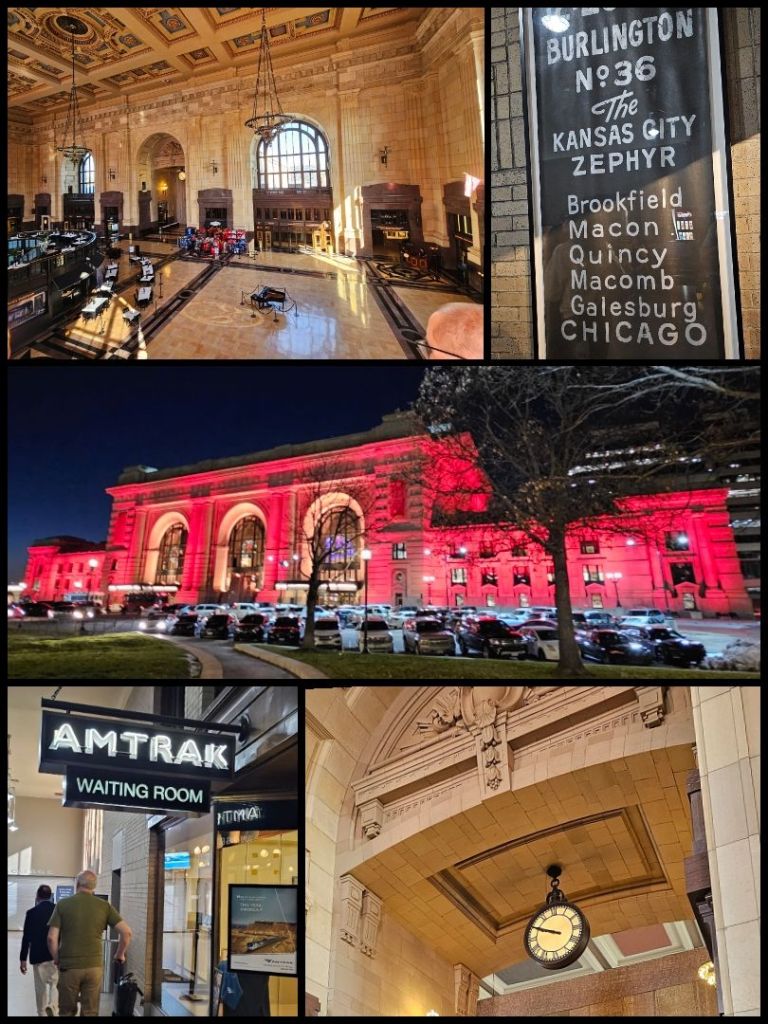
Kansas City Union Station during my tour in 2023
Still, I couldn’t help but dream. As a railroader, I yearn for any and all industry growth, and after having received an absolutely brilliant, behind-the-scenes tour of another iconic masterpiece, Kansas City Union Station, by none other than Station CEO George Guastello in 2023, I saw the historical parallel.
In Kansas City, just like in Detroit, you had an iconic train station that had fallen into disrepair amidst a stark decline in ridership with Amtrak ceasing operations in 1985. What would eventually follow, was an incredible resurgence and restoration effort to faithfully recreate Union Station into what it once was thanks to five counties within Missouri and Kansas City who voted to approve a 1/8 cent sales tax. The remaining funding required for the $250M restoration project was provided through private investors, and federal funding, with the restoration completed in 1999, and Amtrak resuming rail service in 2002.
Amtrak still serves Kansas City Union Station to this day, with myself counted amongst the more than 110,000 riders who have pass through annually.
Could such a service be restored to Michigan Central Station? Could riders soon be connected from Detroit to Chicago, or Kansas City, or New York once again? One can hope…
After nearly an hour, we made our way through the exit, passing a section that had been intentionally left with graffiti adorning the walls, which I felt was a beautiful touch to remind us, and future generations, just how far this building had fallen from grace, and how far it had come.
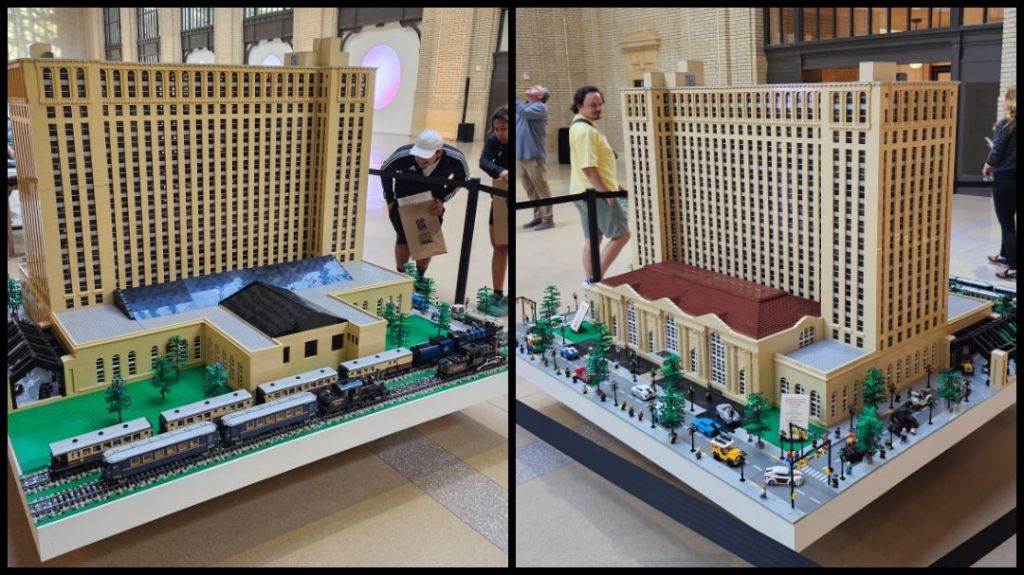
As a lifelong fan of Lego building bricks, I couldn’t help but adore this recreation of Michigan Central Station that was on display
I took a few final looks at the station as we walked away, and I left with a sense of pride in what they had been able to accomplish. The last time I had been this close to the iconic structure, it had appeared as if the challenges required for anyone to restore such a building would be insurmountable, but I’m reminded of another time when people taunted Ford with an insurmountable challenge.
In looking at Michigan Central Station, just like in 1966 when Ford was told there was no way they could possibly beat Ferrari at Le Mans, the Ford Motor Company spared no expense to come out on top.
The familiar smell that seems to accompany all Post Offices permeated the air as I stood at the counter of our local branch with my wife and daughter as we worked through our passport applications, and, in my case, a renewal. The postman behind the counter assisted my wife, and out of the corner of my eye, I noticed an older gentlemen enter the queue, and eventually make his way to the adjacent window in which he was assisted by a postwoman in what I over-heard to be his own quest for a passport renewal.
Turning to get a better look, I recognized him immediately.
“Well,” the postman began, snapping me back to the task at hand, “two of the three sets of pictures turned out alright, but one set was blurry, so we’ll need to take yours again,” he stated as he gestured towards my daughter before walking through a door that led to the Post Office lobby where the photos were to be taken.
Turning to me, my wife inquired, “Well, do you want to go with her, or stay here with the paperwork?”
I elected the former, and we made our way into the lobby where a make-shift backdrop was positioned behind a stool to allow the dull, personality muting passport photos to be taken.
While becoming lost in the surroundings as the postman made adjustments to his camera, I noticed a plaque on the wall that celebrated this building having been erected in 1986, with names of the sitting notable positions of the day, like President Ronald Reagen, as well as the Postmaster General, whose name eludes me at the moment.
As the postman wrapped up a much clearer, more acceptable image, I noticed the older man I’d observed previously walking towards the exit.
In that moment, I had two options. Either I allowed him to leave and I’d miss an opportunity, risking a very real potential that I may never see him again (let’s be real, none of us are getting any younger), or I intercept, and engage him in a discussion.
Anyone that knows me already knows that I chose the latter. I’m not a big fan of regrets.
“Mr. Moreland!” I exclaimed as he walked through the first set of glass doors that brought him into the lobby we’d be standing in.
As a bemused look crossed his face, I outstretched my hand, and continued, “Dave Foster! I was a percussionist in your classes many years ago. You were my first band instructor.”
“Dave!” he acknowledged, gripping my hand.
I appreciated the pleasantry, although I was fairly certain that my face, and name, were both likely lost in a sea of thousands of students he’d had over his several decades of teaching. With my classmates bringing up the tail end of his career, I didn’t expect that his mental hard-drive would be able to quickly access such information, but he powered on, simply knowing that I remembered him, and that it didn’t necessarily matter if he remembered me.
“What are you up to these days?” he asked.
I informed him that I’d become a railroader and held several positions ranging from Freight Conductor to Locomotive Engineer, and then made my way into management as a Trainmaster, and now a Manager of Safety and Training, I was sure to let him know that I’d continued my time on the Drumline and as a percussionist all throughout high school, and I proudly beamed that I’d spent a lot of time in a hard rock band, and that I still play to this day.
After admitting that he’d never delved into learning how to play a drum-kit due to being unable to afford one when he was younger, in spite of the prodding of his friends who believed it would be easy enough to buy his own “after a few gigs,” I shifted the conversation, introducing my daughter. I then informed him that she, too, had an interest in music as she passively dabbles with a guitar and drum-set of her own.
They passed a few words, with my daughter displaying her shyness, and eventually, identifying the subtle awkwardness that exists in a 10-year-old child, I sought an opportunity to get to the point that led me to disrupt the flow of Mr. Moreland’s day.
“Alright, so I remember in 7th or 8th grade, you had composed an original piece that we performed. I think it was called ‘Echoes From The Dragon’s Lair’. Did you ever get a recording of that? I’d love to have it…” I began.
“Ah! Yes! It was actually called ‘Sounds From the Dragon’s Cave!'” he exclaimed, as his posture straightened, and his face was illuminated with pride. “Unfortunately, we never recorded it, or produced it- It wasn’t very technically complicated, it was just a simple composition that was meant to help younger musicians learn to play together as a group.”
“Well, I just wanted you to know that- what, 30 years later? However long it’s been, I still remember that piece, and it touched me enough that I’ve thought of it for all these years.”
I saw tears form in his eyes, and his voice trembled as he said, “Well, thank you Dave. I don’t think you know exactly how much that means to me…”
He paused, then continued, “…you know, you’d never know this, but today has been a pretty rough day for me, and that just completely made my day. I… thank you.”
“No, thank you… and if you ever do something with that piece, please, let me know.”
He took down my phone number, and before shaking my hand again to go our separate ways, he looked to my daughter and said, “You know, Mrs. Murdock probably has a copy of Sounds From the Dragon’s Cave, so when you get to her class, make sure you ask her about it.”
He shook my hand, and we parted ways, both of us wearing smiles from the encounter.
After we completed our business, and the applications were mailed, we stepped through the glass doors that lead to the parking lot, and I turned to my daughter and asked her what she’d learned.
“Well… I learned that he was your first band teacher,” she said innocently.
“Well, you’re not wrong, but what I’d hoped you’d learned was that you never know what kind of a day someone is having, and sometimes, just saying something kind to them can change everything, so if you ever have something kind to say to someone- Make sure you do.”
I recently saw a post asking, “Is Gen-Z lazy for not wanting to work 40-hours a week?”
While I’m willing to bet that your first thoughts are either “Hell yes!” or “Ok, boomer…” I believe the answer is more complex, but I can empathize with both sides.
The fact of the matter is, as we came out of the COVID-19 pandemic, many people began to realize that we only have a finite number of days on this planet, and fewer and fewer people want to spend those days toiling away for the vast majority of employers that view them as expendable to begin with…
In my lifetime, I’ve been employee 039818, 16, 52, 161361 and 353, but ultimately nobody’s epitaph reads “dedicated employee,” they read things like “devoted father,” “caring mother,” or “beloved brother/sister,” so what’s the value in feeling prideful about working an excessive number of hours unless you’re doing something you absolutely love?
While I consider myself fortunate to have found a great work / life balance doing something I enjoy, I previously spent 12 years working for one of North America’s largest railroads, and although the money was absolutely fantastic ($160,000/yr for a job that requires only a high-school education), I got to hear about my daughter’s first steps, first words, and a myriad of other “firsts” through telephone conversations with my wife from a dingy hotel room. Those are missed memories that I’ll never get back, and for what? So I could buy a nice car? Have the newest cell phone? Go out to eat more than was necessary?
Thinking back further, I can still recall a younger version of myself that bragged about working 28 days in a December while I was at Guitar Center. I wore it like a badge of honor, but you know what I wasn’t doing? Spending time with my friends, and actually enjoying my life. I wore that wasted time (at minimum wage) as a badge of honor. Factoring in that that 1 of those 3 days off was Christmas, I now find it all a bit embarrassing that I had so sorely misplaced my priorities.
Ultimately, I believe we’re so brainwashed into believing that success is measured by earning potential, or material possessions that we lose sight of the fact that tomorrow isn’t promised.
We only view those that are fighting for a less-than-40-hour-workweek as being “lazy” because we’re comparing them to our own experiences- what we’ve had to endure, or the jobs and/or careers we’ve chosen, but life doesn’t have to be difficult for someone else just because it was for us, and shame on us for believing it should.
I’d like to believe that those following in our footsteps can have a better road because of us, and as far as I’m concerned, laziness is a measure of the effort you put in while you’re at work, not the number of hours you work.
Grind all you want to, and chase that paper, but don’t chastise someone else for having different priorities than you. ♥- DMFF
When I married your mom, I wasn’t a dog person, but she was a package deal, and with her, I became the caregiver for her hound dog, Jake. He was a squirrely rescue that had all the signs of having been abused as he was timid and untrusting of males until you earned it. Unfortunately for us, at the age of six, Jake began defecating and urinating within the home, and what we believed were behavioral issues resulted in the veterinarian diagnosing him with acute liver failure.
Although his mannerisms towards me made him, at times, difficult to deal with, his jaundiced eyes belied the youthful exuberance that existed in a body that had failed him far too soon, and even I, the lover of cats, and someone that claimed not to be a dog person, was heartbroken.
I held him until he passed, and cried as I gasped for air. It was the hardest thing I’d ever had to do, and I struggled to come to terms with it for weeks.
Then came a newspaper article about a litter of German Shepradors about 30 miles away, and your mom was adamant that we “check it out.”
“Grab money,” I told her, “I know me, and if I fall in love with one, I’m going to want to bring it home.”
When we arrived, there were two dogs left; You, and your brother. In retrospect, one of the greatest regrets in my life is that I didn’t adopt both of you that day, but I went with my gut instincts, and you have become the greatest dog I’ll ever have.
Although it felt much too soon after Jake’s passing to bring home another dog, I couldn’t believe how you were able to heal our broken hearts in a way that I’ve learned only a dog can.
Eventually came your sister, the tiny human, and eventually your chocolate lab brother, the lovable idiot that we tend to think you still believe is a practical joke, although you’ve embraced him, even if you obviously find him annoying.
Through career changes, familial evolutions, accomplishments, a global pandemic, ($12,000 in surgeries for your cranial c and countless losses, you’ve been our faithful companion, loyal provider of kisses, and occupier of foot-space on the bed, resulting in us sleeping with our knees in our chest, but we wouldn’t have it any other way.
Now that you’re 11, not a day goes by that I don’t think about the inevitable day that sees you leave this world, and no matter how much I may know that, when that day comes, it’s time for you to go, I’ll never be ok with it. You’ve been here for so many chapters in our lives, that it’s hard to imagine writing any without you.
Someday, we’ll have plenty of leg room, our wood floors won’t feature muddy paw prints, nor will they be littered with tufts of white hair that we affectionally refer to as “Harley Glitter” or “Tumble Harleys,” but I’d much rather have all of those small mementos than lose you.
So just know, that with every treat, and every belly rub, and every moment I spend with you, you’re often one of the best parts of my days, and although someday you will be gone from my life, you will live forever in my heart, and in my memories.
Until then, let’s enjoy each and every moment we have together… I love you, buddy.
The Easter Bunny, Santa Claus, the Tooth Fairy, and her Elf on the Shelf “Bell,” I often look at my daughter with a sort of envious admiration. Her ability to blissfully believe, and to see the good in so many situations, unjaded by the world around her, is something I genuinely miss and adore.
Don’t get me wrong, I’m not a pessimistic person by most accounts, but I’m also not exceedingly optimistic. For me, the glass isn’t half full, nor is it half empty, but rather, it’s twice as large as it needed to be. I am a realist. I see things as they exist, albeit perhaps with a tinge of optimistic cynicism, depending on the circumstances.
Even on the eve of her tenth birthday, I’m watching her play with Bluey figurines on the living room floor as she binge watches the award-winning show on our television, something that has become engrained in our familial subculture, often finding us all watching it together.
There’s a big part of me that remembers my own youth, in which I probably played with Lego much later than many of my peers likely did (I never stopped, actually), as well as other toys such as Micro Machines, and die-cast toy cars.
In reading about the developmental differences of only-children in Psychology Today (which is something I have in common with my daughter), it’s asserted that certain likelihoods can exist, such as academic exceptionalism due to receiving so much unilateral attention, as well as a higher propensity for imaginative play due to not having siblings to engage in play with.
All of that seems to check out for both of us, as I couldn’t begin the count the endless hours spent cross-legged on my bedroom floor as I’d build creatively technical models out of Lego, and act out wildly imaginative scenarios with the iconic minifigures.
As years would pass, the Lego collection would be stowed away in plastic bins (thankfully never to be sold or discarded), but I’d continue to sporadically add to the collection here and there, with much less frequency until the COVID-19 pandemic reignited my life for the colorful plastic building blocks.
Although my childhood innocence was lost well before then, throughout those years in-between, I’ve become somewhat jaded by the world that exists around us as the reality of becoming an adult have set in. Amidst all of the responsibilities of existence that everyone endures, there are also the frustrations that exist with the political and social climate as the divisiveness of our duopoly continues to drive a wedge further between not only the political parties, but also their voters. The alienation that exists is likely what precludes me from aligning with either of the two major political parties as I find them both to be fairly deplorable for different reasons.
I’ve made a career out of leading grown adults (well, most of them) in an extremely unique and demanding industry, and only in recent years have I found ways to compartmentalize how I handled situations at work when compared to how I handle situations at home. On the railroad, there was always a reasonable expectation that people adhered to a certain set of rules, policies and federal regulations, and it was my responsibility to hold them accountable for their actions, however, at home, when you find yourself striving to mold a child into a respectful, caring, intelligent being, there is no rule book- You simply must figure it out on your own, taking cues from family and friends as to what methodologies you believe will be the most effective.
However, I’ll admit, fatherhood hasn’t been an easy road for me.
Unfortunately, in the earlier years of my daughter’s life, I was much less… empathetic. Much the same as I had no rule-book to reference on how to be a dad, she also had no rule-book on how to be a child. I’d often resort to raising my voice, or yelling, to get her attention, and although effective at accomplishing that goal, in retrospect, I can’t say it was healthy, or well received, as I’d had a few friends point out that I was being too hard on her.
It took me a while to realize how important it was that I actually take the time to listen to what she has to say so I can better understand her perceptions of the reality that exists in her mind, and to empathize with her problems, and how I can help her tackle them. This has opened up untold opportunities for dialogue to help guide her in difficult situations with kids at school, the dynamics that exist amongst groups of friends, schoolwork, sports, and the other perils of being a kid, especially in times like these.
I hope someday she realizes everything that’s gone into the opportunities that we’ve provided for her to have the childhood that she’s had, and it goes well beyond the things she has (and Lord knows she’s got plenty of things), but more importantly the things we’ve done. The hockey games, the trips to Disney World (and Disneyland in a few short weeks), North Carolina, Tennessee, the Sunday afternoons bowling, the game nights, and everything else we do as a family…
Admittedly, only recently have I begun to feel like I’m somewhat alright at this whole fatherhood thing, but I still recognize that I’ve got a long way to go to become the dad I want to be, although I think that’s always a work in progress that likely never ends, but when it comes to being a parent, as long as we’re trying our best, we’re probably doing just fine.
I laid in bed for quite a while after waking up this morning, my face aglow from the dim light of my cellphone as I doom-scrolled through social media, a guilty pleasure of mine.
My head perched atop two pillows, with one slightly offset to create somewhat of an incline, I forced my neck and head into their softness, feeling the pillows give way as the sound of my spine grinding, and eventually popping, permeated through my skull. I felt the familiar clicking of my vertebrae adjusting into position radiating into my shoulders, as a sensation that I could only describe as a million pin-pricks cascaded through my right arm and into my hand.
Such has become the norm as I foray into my second major chapter of living with spinal stenosis, a condition that sees the spinal canal of the diagnosed narrow over time, resulting in neurological issues as the spinal cord itself becomes compressed.
Although in the past few years I’ve dismissed the Parkinson-like tremors I’ve experienced through my biceps, and triceps, and my decreasingly steady hands, but as the agonizing shoulder pain, numbness in my hands, and tingling in my arms set in, I had a good hunch as to the source.
In 2013, after an inexplicable onset of partial paralysis in my left arm that saw me unable to perform simple tasks, such as lifting a gallon of milk, and with excruciating pain in my neck that left me unable to sleep, several visits to my primary care physician came to a startling, at least to me, diagnosis. My doctor, who attempted to write it off as a pinched nerve in my neck due to having slept wrong, would eventually send me for an MRI, and upon calling me in for a follow up appointment, broke the news to me.
He began- “Well, David. I have some good news, and some bad news,”
Rarely taking anything too seriously, I retorted, “Alright, Doc, shoot it to me straight, how long do I have to live?”
“Well, you’ll never play in the NFL,” he quipped.
“Well shit, doc! There goes my fuckin’ backup plan if the railroad didn’t work out!” I joked back, both of us attempting to lighten the mood.
Through his thick Jamaican accent, he continued- “You have a condition known as spinal stenosis, which means that your spine doesn’t have as much room as it needs, and your C5 and C6 vertebrae have shifted, and they are impinging upon your spinal cord, which is causing the paralysis. We’re going to try some physical therapy, and hopefully that will get things back where they should be. Ultimately, you need to avoid high-impact things like running, horseback riding, roller coasters, and things like that, because they can cause complications, up to and including complete paralysis.”
So there it was. Luckily, as a rabid fan of the Corvette, which breaks up it’s generational production periods as “C1 (1953-1962), C2 (1963-1967), C3 (1968-1982),” etc…, it was quite easy for me to remember that the C5 and C6 were the vertebrae impacted.
Fortunately, through physical therapy, which saw me fumble through a myriad of exercises, deep tissue massages, and even traction, which had my body affixed to a bed while a device, strapped to my head, stretched my neck with the ultimate goal of pulling the vertebrae back into their proper position, eventually set me right. The strength returned to my left arm, as measured by a grip strength measurement tool via my hand, and by tracking the increases in weight through my exercises, and the numbness, although never completely gone, was much less noticeable, at least to the extent that I could return to work and function normally in my day-to-day goings on.
Either way, knowing I had this unpredictable ticking time-bomb that could be triggered by nearly anything, especially at work, which saw my body frequently endure unpredictable impacts as I rode on the side of railroad cars, was disconcerting. As quickly as my seniority allowed, I entered locomotive engineer training, and upon being furloughed (a common railroad industry term for being ‘laid off’), I entered management in 2016, all of which served to reduce the risk potential for triggering my spinal stenosis.
Fast forward a decade, and here we are. Likely triggered through riding rollercoasters at Dollywood over the summer (what an absolutely blast), my symptoms have returned, but reversed- This time in my right side. Luckily, this time around, I haven’t experienced the lack of grip or muscle strength that I felt in 2013, but the pain, and numbness are very similiar.
An MRI was ordered, and the results were disheartening. The issues were now between my C4, C5, C6, and C7 vertebrae, and my spine was now arthritic. Two discs had degenerated to the extent that, although my body attempted to regenerate them, since it could not re-create Cartlidge, it created bone spurs instead.
So here I am. 40 years old, with arthritis in my spine, and bone spurs and shifted vertebrae impinging upon the nerves of my spinal cord to trigger phantom pains in my neck and shoulders, and numbness into my right arm.
Still, I’m painfully aware that things could be much worse as I empathetically watch a close friend of mine, a former Army Ranger in peak athletic form, in his battle through Stage IV cancer, with his most recent surgical procedure serving to remove the left lobe of his liver. He died on the operating table, but was thankfully brought back to tell the tale.
As for me, it was back to physical therapy, however, this time around things would be different. As it turned out, the insurance we now carry would not cover the therapy until our deductible was met, and although it was a good sign that my family was healthy throughout 2023, meeting my deductible in the end of November didn’t seem like the greatest financial decision (hooray for the American medical system), so I decided to hold off until January. Fortunately, through the few visits I did engage in, I was able to right the ship enough to keep the symptoms manageable enough to make it into 2024.
With that said, I’m very much enjoying everybody’s highlight reels on social media as they post pictures of everything they loved about 2023, and even I have a veritable smorgasbord of highlights to be grateful for, but I’m looking forward to 2024 as a jumping off point for the next chapter of what should be, hopefully, a happier, healthier, and more financially sound me.
Oh, and my new years resolution is to entertain you all (all two of you that read this) with at least one musing per week as I explore, in raw honesty, my life, and the world around me, so subscribe to stay tuned for what is to come.
The bright blue sky greeted me this morning with beautiful rays of sunshine piercing through the gaps in the curtains as I strolled through my home, opening windows to let the fresh air fill the house.
The sound of a small propeller powered aircraft flying at low altitude overhead punctuates the soundtrack of life as the wind blows through the leaves, rustling in a natural white noise, with the blissful sounds of birds chirping, and wind-chimes crafting their natural song as they sway in the breeze.
The weather is eerily reminiscent of this day, albeit slightly cooler, twenty years ago.
On that day, which I still remember so vividly, at just about the same time, I was in second period at Swartz Creek High School, and the Football season being upon us, we found ourselves engaged in Marching Band rehearsals on the Football Field. By this time in my life, I was a senior, and our ‘Center’ Snare Drummer, but I’d become entitled, and lazy when it came to my rehearsing- We’ll call it Senior-itis. I remember looking down upon my Premier Snare Drum that lay on the freshly cut turf, it’s gleaming deep red shell glistening in the sun, perfectly offset by bright white hardware. We were the first class to have received these gorgeous new drums, part of a complete set that included tuned bass-drums as well as quads, and they were truly beautiful instruments to behold.
As many of us began to take our positions in formation on the field, one of my classmates burst onto the field in full sprint from the band room, shouting that someone had flown a plane into the World Trade Center, and that it was on the Television in the classroom. I assumed it was a mis-guided small private aircraft, like a Cessna, that had lost control, but never one to let a good excuse go to waste to abandon whatever I was supposed to be doing, I ran inside to see what all the commotion was about.
When I entered the class room, there was a small gathering of students and faculty watching the events unfold on the Breaking News story that had interrupted the regular programming.
Although, academically, the rest of the day was a blur, I remember moving from classroom to classroom throughout the periods, with rumors and spotty information swirling. We’d heard about the Pentagon, and the twin-towers collapsing. It had already been claimed that this was a terror attack, but updates passed from student to student like a terrible game of telephone, and none of us truly knew the full scope and breadth of what was happening.
In what I can remember to be the first time in my life that I’d realized the world of 24-hour news coverage meant simply being first, and not necessarily being correct, mis-information, and incorrect details were serving to muddy up the truth, and while the events that were unfolding were horrific in and of themselves, the sensationalized claims were worse.
In the hallway rumblings, we’d hear that the Statue of Liberty, the White House, the U.S. Capital, and numerous other notable buildings had also been hit. This, obviously, turned out to be untrue, but we had no way of knowing what was true, and what wasn’t.
Some class-rooms had their televisions on, with students, as well as teachers, many of whom had given up on attempting to compete for the students’ attention, fixating on every update.
I remember sitting in my fourth period Government class, and one of my classmates being nearly inconsolable after receiving a text message, something that was a new and exciting technology for us at the time, that his brother was being immediately deployed, but to where, and for what, still remaining a mystery. My teacher for that class, a former United States Marine, and U.S. Army Drill Sergeant, allowed us to discuss the events amongst one another in an open forum, helping to shift the conversation away from as much of the mis-information as he could. Other teachers would pop in and out, obviously respecting the experience of his military and government knowledge.
The bus-ride home was somewhat typical, although I can recall seeing all of the students filing out of the High School like zombies- Shell shocked at what was happening, and unsure how to process it all in our emotionally stunted, intellectually immature reasoning capabilities that were underdeveloped, yet would somehow never remain the same after that day. I took my usual seat, all the way in the back of the bus, passenger side, and slipped my Sony headphones around the back of my head and over my ears, plugging them into my well used Aiwa portable CD player (that I still have, working faithfully to this day). While I don’t recall the album, I’m sure it was something by Metallica, which was also a nickname I’d earned amongst the Marching Band for having had a collection of Metallica T-Shirts so vast that I could go several months without wearing the same shirt twice.
Getting home from school, I can remember holing up in my bedroom and gluing myself to my television set, watching the live footage as rescue efforts were underway in New York City. Slowly, reports would begin to surface about who was claiming responsibility for the attacks. New York Mayor Rudy Giuliani and U.S. President George W. Bush would both make poignant speeches from the rubble that day that elicited a feeling of patriotism, and unity.
I remember watching updates deep into the night, as the flickering light of the television set lulled me to sleep. I felt angry, and sad. Coming from a family deeply rooted in military service, I wanted revenge, and like many, I didn’t care who that revenge was carried out upon. I was just a naïve 18-year-old kid, looking for a fight to avenge a wrong that was carried out on my people.
In years since, I’ve heard people say, “I miss September 12th, I miss the patriotism, and people putting differences aside to come together” and while I’ll readily admit that I, too, miss the unity, and feeling of commonality that resulted, I just wish that it didn’t take such an atrocity for us, as a nation, to come together in support of one another. In the two decades since, war, racial tensions, concerns over how the police actually police, general political divisiveness of our inept leaders (on both sides), and a global pandemic have lead us to become the most divided we’ve likely ever been in our 245 year history.
Still, at that time, many from my generation answered the call following September 11th. Most would enter the military, and while I intended to do the same, physical ailments (mitral valve proplase, and spinal stenosis) precluded me from military service, so I dedicated my efforts to supporting my community by joining my local paid-on-call Fire Department, inspired by the 343 New York Firefighters that selflessly gave their lives in efforts to help complete strangers that were trapped in the World Trade Center.
A lot has changed since September 11th, 2001. We said we wouldn’t forget, but I believe in a lot of ways we have- We’re more deeply divided than I’ve ever seen, and patriotism feels to be at an all time low. Don’t get me wrong, I don’t believe in blind patriotism, nor unfettered nationalism. It’s one thing to be proud of your nation, and your government, but I don’t think we’re in a position to truly be proud of either right now, and regardless of where you stand on what actually happened 20 years ago, it’s hard not to admit that we’ve willfully allowed ourselves to be stripped of countless freedoms in the aftermath of 9/11 in the name of safety, and security (Enter a global pandemic, which has us doing that very thing yet again).
I don’t mince my words in that I still think we’ve got a lot of things to be grateful for as Americans, and I wouldn’t wish to live anywhere else at the present time, but I also don’t believe we’re perfect, and I still think we’ve got a lot of work to do to achieve the ideals that were penned by our forefathers. To that end, while many will criticize their hypocritical ways, it is the concepts they laid out, not the way in which they were executed, that I celebrate and still hope to see achieved within our nation. Most notably the “All Men Are Created Equal,” and the concept of “Life, Liberty and the Pursuit of Happiness.”
As a good friend pointed out today, I’ve now lived more of my life post-9/11 than pre, which is an odd thought to embrace, but two decades removed, it’s amazing how vividly I can still remember the details of the day that the skies fell silent.











 From the desk of Dave Foster