
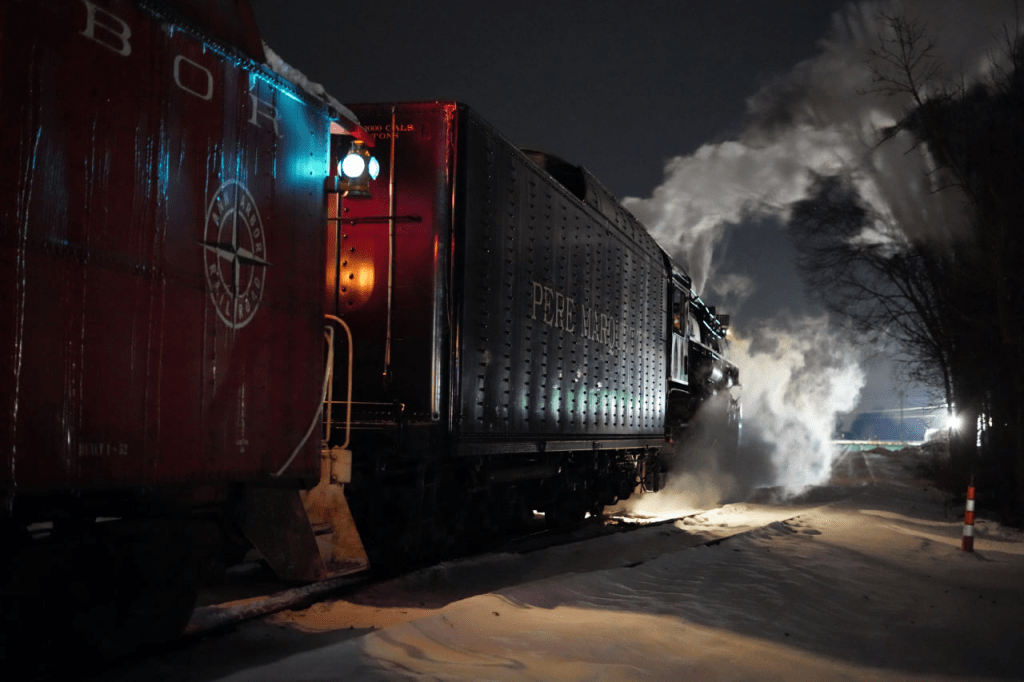
I flung the car door open to hear the inimitable sound of a brass Nathan 6-chime whistle howling into the cold December night. Just as has been portrayed in so many country-western songs, it’s hauntingly lonesome note echoed across the landscape as a column of black smoke and white steam plumed into the evening sky, breaking up the otherwise waning hues of blue that were rapidly giving way to the darkness of nightfall.
As we stood within the Steam Railroading Institute’s Visitors Center, it was hard not to feel the buzz of holiday excitement that emanated from the crowd of people that were browsing the gift shop, snapping selfies in front of a Christmas themed wall, or waiting in the will-call line, like us, to pick up their tickets for the evening ride.
At an organization that prides itself in being the curator of notable railroadiana, even the Visitor’s Center holds a rich history all its own, which over a century ago served as a Freight House for the Ann Arbor Railroad to move the furniture and caskets that were manufactured by the talented woodworkers of the area. After changing hands a few times, the building was acquired by the Steam Railroading Institute over 20-years ago, and has since been renovated to serve as a museum to display vintage railroad artifacts, a model train layout, and also handle the ticketing for their many passenger excursions throughout the year- Most notably those held around the Christmas holiday to celebrate Chris Van Allsburg’s iconic 1985 Children’s book, The Polar Express.
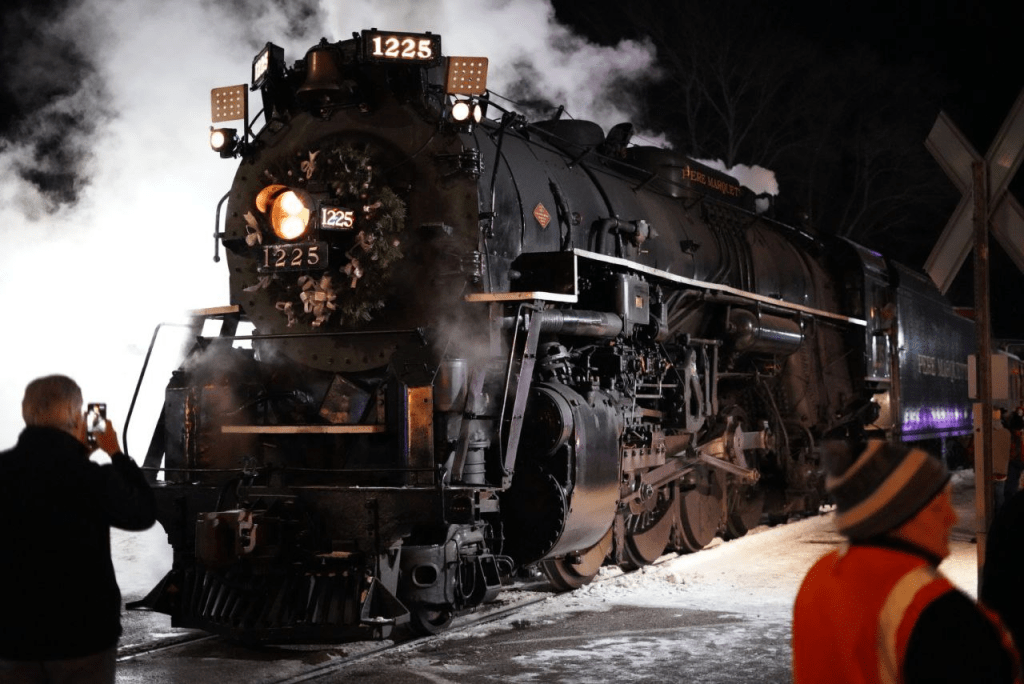
In 2004, the book would become the inspiration for a live-action animated movie directed by Robert Zemeckis, and starring Tom Hanks, which has its own ties to the Steam Railroading Institute as the Warner Bros. film crew travelled to Owosso to record the locomotive sounds for the film by utilizing the iconic Pere Marquette 2-8-4 Berkshire, which fittingly enough bears the road number “1225.”
In fact, it was the locomotive’s road number, and its perceived symbolic connection to Christmas that spared the 1225 from the scrappers torch when it was retired, eventually finding the behemoth being placed on static display at Michigan State University in 1957.
In 1971, the university railroad club began undertaking the daunting task of bringing the 1225 back to life, successfully firing the boiler and sounding the whistle in 1975, moving the locomotive under its own power in 1985, and eventually allowing the 1225 to begin its second life as a passenger excursion locomotive in 1988.
37 years later, my family and I stood patiently in the “A-G” line, patiently waiting to retrieve our tickets. It’s a train ride we’ve taken many times before, but this year was different. This year my mother had decided she’d prefer a quiet evening with her family in the privacy of a caboose.
Fortunately, as I close in on my fifteenth year of railroading, I’ve made a lot of friends along the way, including a gentleman by the name of Mike Burgett, who I met while working at CN. A man who is fairly well known in both the railfan and railroading communities, Mike previously served as the Senior Manager of Engineering- Signals Design at CN and now serves in the office adjacent to mine as the Chief Engineer for Communications & Signals at Lake State Railway Company. (Gosh, Mike- Why are you so obsessed with me?)
Since working for the railroad doesn’t provide him with enough time around trains, he spends his evenings and off days working on his world-renowned HO scale model-train layout, which portrays the Chesapeake & Ohio Clifton Forge Subdivision in breathtaking detail, just as it was in 1965. He also spends time volunteering at Henry Ford Museum & Greenfield Village (celebrating his 25th year in 2022) and serves on the Board of Directors at the Steam Railroading Institute.
Whew…
…but once upon a time, Mike was a railroad obsessed boy with a dream.
By the 1980’s, evolutions in technology had reduced the number of employees required to serve as part of a train crew which virtually eliminated the need for cabooses.
Railyards across the country began to find tracks filled with the once ubiquitous symbol of American railroading- a critical component in any model trainset to this day, but everything has an expiration date. CSX’s Saginaw Yard was no different, as a line of cabooses sat awaiting their disposition, and one could be had for a cool $1,500 (about $4,000 in 2025) so long as the new owner could successfully relocate the car.
While $1,500 was an undeniably fair price, it was still a bit out of the financial reach for a then 10-year-old Mike Burgett, so after much badgering, his mother finally relented and penned a letter to CSX’s corporate headquarters to ask if they might consider a discount for the budding rail-buff. Much to the Burgett’s surprise, a phone call several weeks later would find them as the proud new owner of a caboose, so long as they could work out the logistics surrounding how to relocate the railcar to their property.
Unfortunately, moving a railcar off the rails isn’t quite as simple as picking up a Lionel train car and placing it on a shelf, but fortunately a human-interest story in the local newspapers helped secure the necessary pieces of the puzzle, such as cranes, and even the rail, ties and ballast to place the caboose on at Mike’s house.
The Chesapeake & Ohio caboose that began life in 1941 as wood-sided 90091 and was rebuilt, modernized and renumbered in 1970 as 903674, now belonged to a 10-year-old boy who would make it his clubhouse for the rest of his childhood.
The thing about kids, is if everything goes according to plan, they grow up to become adults, and adults have responsibilities, obligations, and sadly, they no longer have time to play in their caboose clubhouse.
It would sit behind Mike’s parents’ home for decades, and though he had considered donating it to be displayed in the town he’d grown up in, a better option came to light- One that would allow him to, once again, spend as much time as he’d like in his storied caboose.
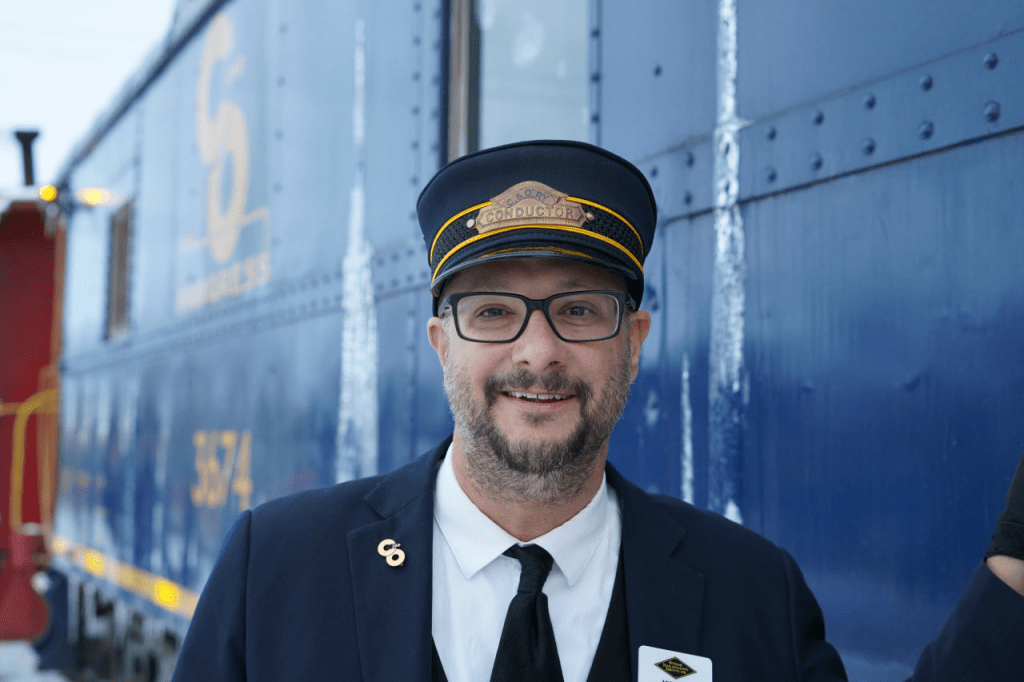
In 2023, Mike would donate the caboose to the Steam Railroading Institute, where he, and the talented back shop team of volunteers, would painstakingly restore the caboose to its original as-rebuilt condition to appear exactly as it would have when it rolled out of the C&O Wyoming Shops at Grand Rapids, Michigan.
If you’re reading this, I’m going to step out on a limb and assume you’re a pretty sharp individual, so I’m sure you’ve connected the dots already, but just in case you haven’t, I reached out to Mike to ensure that the private caboose we were to ride in would be his beloved “3674,” and he graciously obliged.
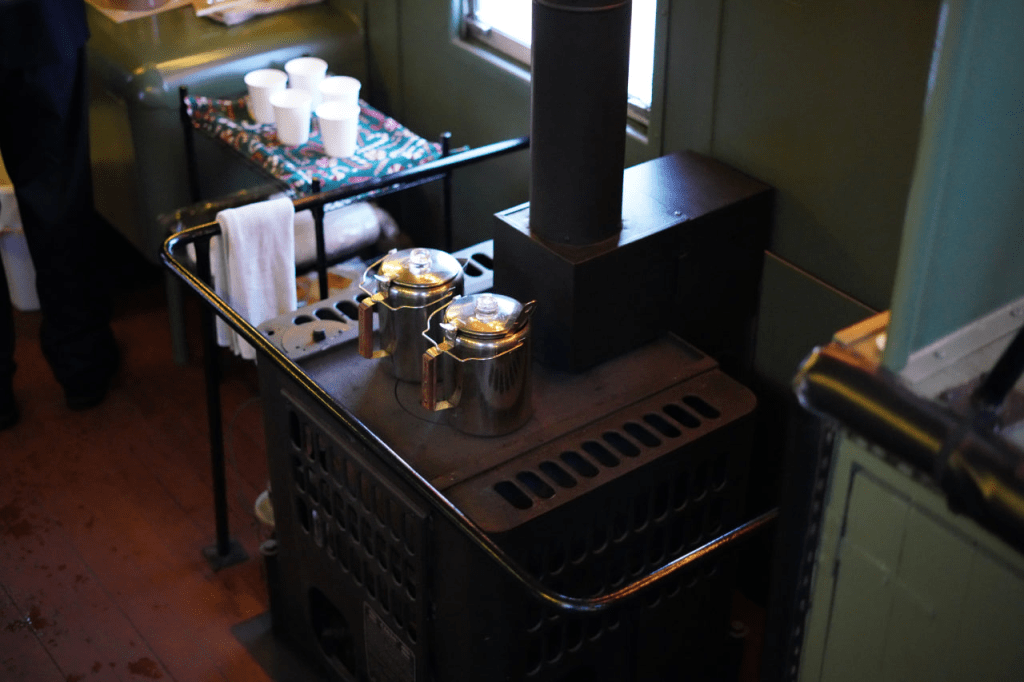
With his caboose positioned just two cars behind the iconic 1225, Mike welcomed us at the admission gate nearest the locomotive, dressed to the nines in authentic C&O passenger conductor regalia. As I approached the car, I admired the metal work that had been completed during its restoration, the blue paint gleaming in the setting sun, and the iconic “C&O For Progress” slogan proudly emblazoned on the side. As we boarded the car and stepped through the “A-end” door, I immediately felt the warmth of the air heated by the caboose’s oil fueled stove wash over me, reassuring me that this would be a cozy, comfortable evening.
As we commenced our 20-plus mile journey to the city of Ashley- er… the North Pole, the cabin of the caboose was filled with the sounds of Christmas music and conversation as we all took turns climbing into the cupola- the watchtower like structure atop the caboose which provides the undeniably best view.
While many of the tickets for the Polar Express include a cup of hot chocolate, Mike boasted that his was the absolute best (and bottomless), and as we watched him prepare it atop the 3674’s original oil-stove, we had to agree.
Since I always keep a deck of cards and a board nearby, it didn’t take long before I challenged my dad to a game of Cribbage, a uniquely midwestern card-game that he had taught me at a young age- Since then, we’ve spent countless hours going back-and-forth counting our fifteen-for-twos, and scoring double-runs as we hoped to avoid being skunked (beaten by at least 30 points), or worse, double skunked (beaten by 60 points or more- it takes 121 points to win). I’m sure it certainly wasn’t the first game of cards played in this timeless railcar, and I wanted to keep the tradition alive as a few years earlier on Lake State Railway’s “Family Day” train ride we had played a few games on the “Dover Harbor,” a legendary Pullman heavyweight car that was built in 1923 and served the New York Central railroad for many decades.
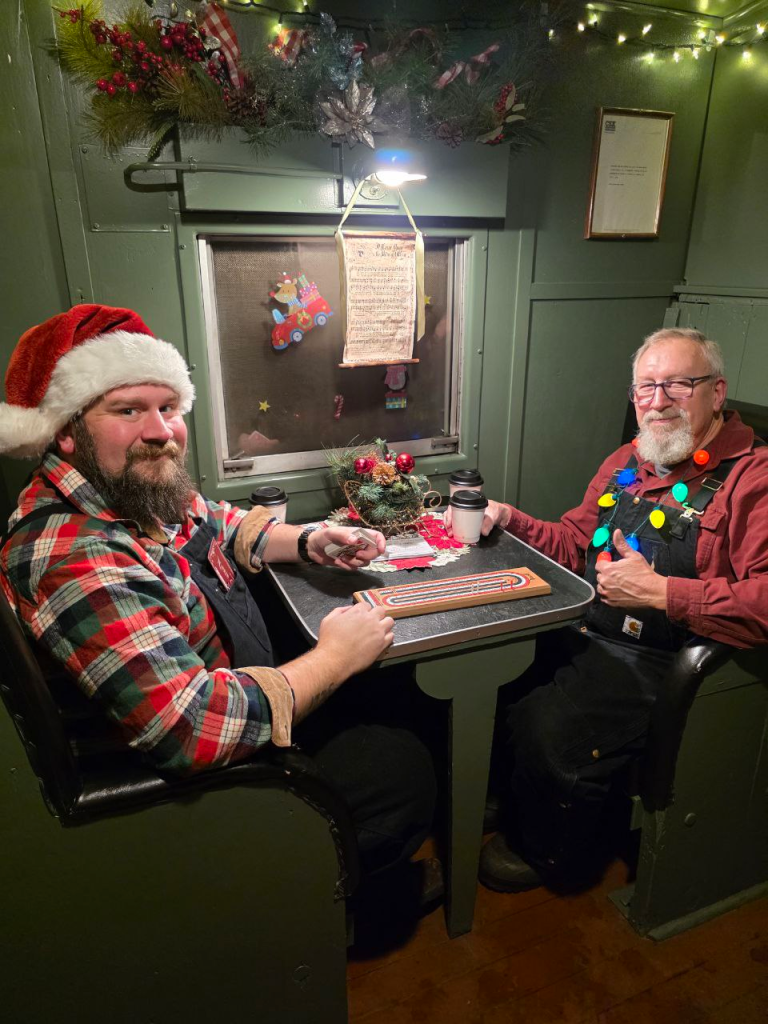
As I pegged the final few points to seize a victory from my dad (the student becomes the master… sometimes…), we were arriving to the city of Ashley, a small town in mid-Michigan that transforms itself to serve as the North Pole for the seasonal Polar Express train-rides. With carnival rides, food trucks, various vendors, and even a sizable Christmas themed model-train layout, there’s always something to do to stay busy for the hour-and-a-half layover. While the food is good (seriously, try the fried Oreos) the star of the show is usually the 1225 as her passengers gather around for photographs of the locomotive that once faithfully served the Arsenal of Democracy as Michigan automotive facilities had been converted to produce tanks, bombers and other commodities necessary for the war effort.
Eventually, after all the pictures are taken, bellies are full, and Santa has drawn for the first gift of Christmas, it’s time for the train to reposition itself for all the passengers to board, which provides one last opportunity for photos of the 1225 pulling the train ahead before a diesel locomotive positioned on the opposite end of the train would tug it back towards Owosso to conclude the journey.
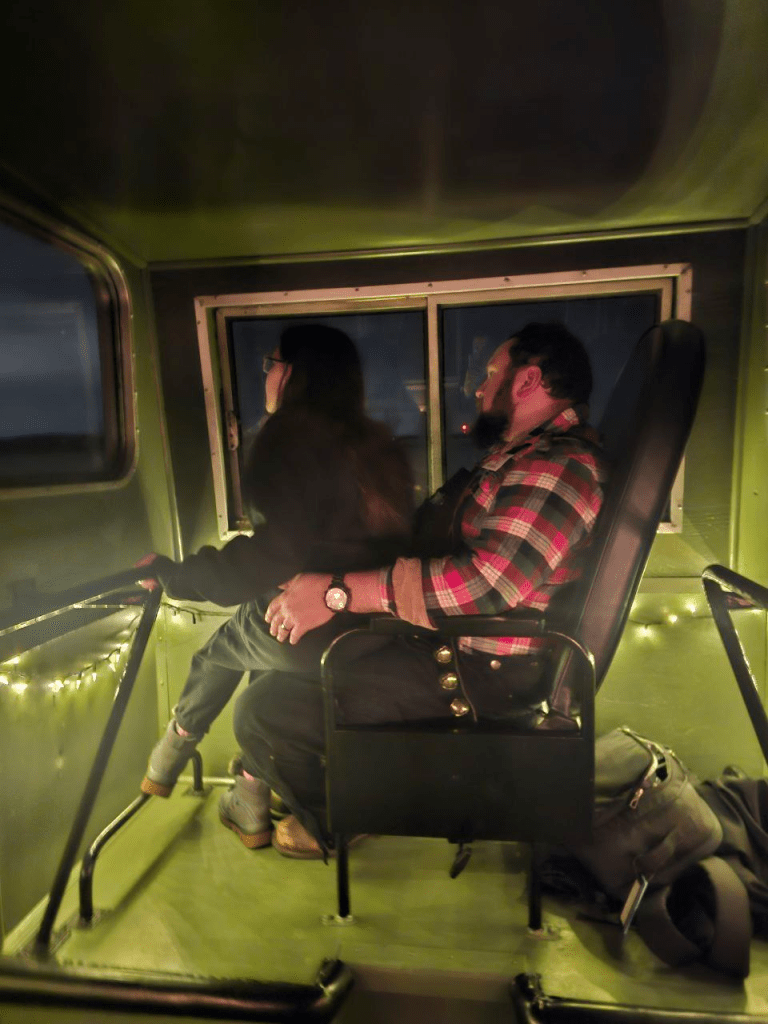
Worn out from the fresh air, aimless wandering, and carbohydrate-induced comas, the ride back was much more subdued, and I found myself back in the cupola, this time with my daughter in my lap. As we admired the Christmas lights that adorned houses along the route, and the railfans who were braving the bitter cold evening to catch a glimpse of the 1225 as it passed, the barrage of questions from an inquisitive mind let me know just how tired she was. Nevertheless, I attempted to satisfy her curious mind, answering as many questions as I could before she eventually resigned to quietly enjoying the ride, and appreciating the passing scenery the way I have for so many years as a conductor and locomotive engineer, crisscrossing the Midwest before making my way into management. Thankfully, she doesn’t remember the early years, or her birthdays that I’d missed when dad lived on the road, the hotels were a second home, and sleep came at a premium, if it even came at all.
Arriving in Owosso, with one more howl from the 1225’s whistle our trip would come to an end, but the prospect of a new year provides another opportunity to make memories with the people that I love, and I long ago learned that it’s not about what you find beneath the Christmas tree, but rather these moments we share with one another that is the real magic of Christmas.
 From the desk of Dave Foster